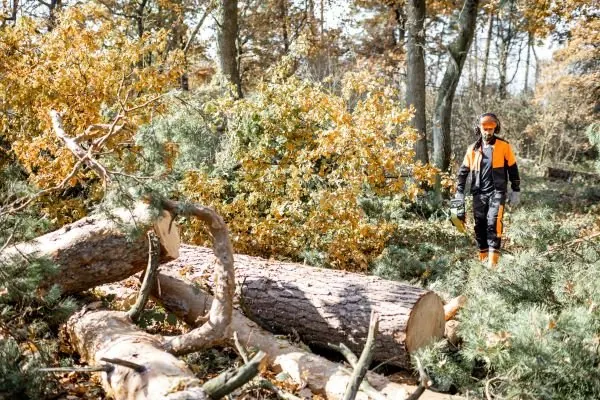
When removal is the right answer
Removal is the right call when a tree is dead, structurally failing, causing damage that cannot be fixed by pruning, or simply wrong for where it is growing. In the City of Kalamunda the common cases are marri with canker that has girdled the trunk, jarrah killed off by dieback, pines that have died back after a long dry summer, and big trees planted too close to houses, pools, sheds or septic systems decades ago.
If the tree is healthy and only a few limbs are the problem, ask about tree lopping first. A mature tree takes decades to replace.
How a hills removal is done
Very few trees near houses in Lesmurdie, Gooseberry Hill, Kalamunda or Walliston can be felled in one piece. There is rarely a clear landing zone on a sloping block, and a falling trunk on a slope can bounce, roll or slide. So most removals are dismantled from the top down:
- The climber ties in and removes the smaller outer branches, dropping them where it is safe or lowering them on a rope.
- Larger limbs are cut in sections and lowered under control, with a ground worker running the rope through a friction device.
- The trunk is taken down in short pieces until the remaining stem is low enough to fell safely.
- Wood is carried or winched to the chipper and trailer, often up a driveway or along a narrow path.
Where there is access from the street or a flat part of the block, an elevated work platform or a crane can lift sections clear instead. On steep blocks that is not always possible, and the contractor will explain the method on site.
Things that slow a removal down
- Slope. Every piece has to be stopped and moved uphill. The steeper the block, the more labour.
- Targets underneath. Roofs, solar panels, sheds, pergolas, water tanks and retaining walls all need protecting.
- Power lines. Work close to overhead lines must be done by people accredited for it, and sometimes the network operator has to be involved.
- Dense hardwood. Jarrah and marri are heavy. A metre of trunk weighs far more than the same length of pine, which affects rigging and handling.
- Septic and leach drains. Many hills properties are not on deep sewerage. Heavy machinery must keep off septic systems, so mention where yours is.
Approvals and native vegetation
There is no single rule for tree removal across the hills. Points worth checking before you book:
- Verge and reserve trees belong to the City of Kalamunda. Do not remove or prune them yourself.
- Native vegetation clearing in Western Australia is regulated under the Environmental Protection Act 1986. Removing a single native tree from a house block can fall under an exemption, but it is worth confirming with the Department of Water and Environmental Regulation if you are clearing more than one or two trees.
- Planning and heritage conditions. A development approval for your home may have included conditions about retaining trees. Check with the City if you are unsure.
- Bushfire planning. If you are building or extending in a bushfire prone area, your Bushfire Attack Level assessment may recommend separation between trees and the house. That can support removal, but it is still worth confirming with the City.
Before and after
On the day, keep cars, pets and children well clear of the work area and leave gates unlocked for the crew. After a removal, the block should be left raked and free of debris, and anything you asked to keep, such as firewood rounds or a pile of mulch, should be where you wanted it.
Then decide about the stump. Stump grinding suits lawns and garden beds. Stump removal suits slabs, sheds, retaining walls and pools. If the tree was killed by dieback, ask the contractor about cleaning soil from machinery before they move on; our dieback guide explains why.