What dieback is
Phytophthora dieback is a plant disease caused by soil-borne pathogens from the genus Phytophthora. In Western Australia the most damaging is Phytophthora cinnamomi. According to the Department of Biodiversity, Conservation and Attractions (DBCA), it is not native to WA; it is thought to have arrived with infected horticultural plants in the early 1900s and has since spread through much of the south-west.
The pathogen lives in soil and in the roots it infects. In warm, moist conditions it produces swimming spores that move through wet soil toward plant roots, attracted by the chemicals those roots release. They infect the roots, and the pathogen grows through them, killing root tissue. If it destroys enough of the root system, or reaches the collar at the base of the trunk, the plant can no longer move water and nutrients to its crown, and it dies.
DBCA describes the effect on natural ecosystems as permanent and irreversible. More than 40 per cent of native plant species in the south-west are considered susceptible, including many banksias, hakeas, grass trees and some eucalypts.
Why it matters in the hills
The Perth hills sit within the part of the south-west where dieback is a long-standing problem. Jarrah forest is among the vegetation it affects, and the scarp's mix of laterite gravel, clay and winter rain gives the pathogen the moist soil it needs for part of each year.
On residential blocks in Lesmurdie, Gooseberry Hill, Kalamunda, Walliston and Bickley, you often see:
- jarrah dying in patches over several years while nearby marri stays healthy,
- banksias and grass trees collapsing in a spreading area of the garden,
- deaths following the line of a driveway, a drain or a path down the slope,
- new deaths appearing on the downhill side of earlier ones.
That pattern of spread downhill and along water flow is typical of a soil-borne disease moving with run-off.
Signs to look for
Dieback is hard to confirm by eye; only a soil or tissue test proves it. But these signs together are a strong hint:
- Sudden death of susceptible plants, particularly banksias, grass trees and some native shrubs, with leaves going yellow then brown while still attached.
- Progressive crown decline in jarrah, with dead tips and thinning foliage over a season or two.
- A front or edge where dead and dying plants give way to healthy ones.
- Resistant species staying green in the same area. Marri, for example, is generally much less affected by P. cinnamomi than jarrah or banksias.
- Association with water flow, drainage lines, low spots and areas where soil has been moved or brought in.
If you suspect dieback, sampling is the only way to know for sure. Specialist plant pathology laboratories in WA can test soil and plant tissue for Phytophthora.
How dieback spreads
DBCA notes that the pathogen spreads naturally through soil and roots and in run-off water, and that animals can carry infested soil on their feet and fur. But it says people have spread Phytophthora further and faster than any other means, by moving infested soil.
The ways people move soil in a typical hills garden include:
- boots, wheelbarrows and tools,
- vehicle and machine tyres and tracks,
- excavators, stump grinders, chippers and trailers moved between properties,
- bringing in garden soil, mulch or fill from elsewhere,
- moving potted plants with soil from infested areas,
- run-off from earthworks and driveways after rain.
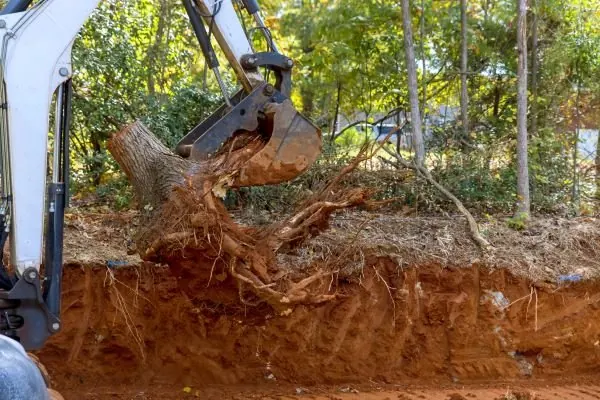
Tree work is one of the most common ways soil moves between properties. A stump grinder, mini excavator or bobcat working in wet ground can carry a surprising amount of mud on its tracks.
Hygiene to ask for
The basic principle of dieback hygiene is simple: clean on entry, clean on exit, and do not move soil when it is wet. When you book tree work, it is reasonable to ask the contractor to:
- Arrive clean. Machines, tyres, tracks and boots should be free of soil and mud from the last job.
- Stay on hard surfaces where possible, especially when the ground is wet.
- Work dry where they can. Scheduling stump grinding and digging in drier months reduces the amount of soil carried.
- Brush or wash down before leaving, within your property, so your soil stays on your block, especially if you suspect dieback.
- Keep stump and root material on site if it is carrying soil, or bag and remove it carefully.
- Avoid bringing in fill or mulch from unknown sources.
Brushing off dry soil is often enough. Where washing down is needed, it should happen where the run-off will not flow into healthy parts of the garden or bushland.
A contractor who mentions hygiene without being prompted is a good sign.
Living with dieback on your block
If dieback is confirmed or strongly suspected, the goal is to slow its spread and protect what is still healthy.
Manage water. Fix leaking pipes and reticulation that keep soil wet. Divert run-off from driveways and roofs away from healthy plants. Avoid creating low, wet spots.
Control soil movement. Keep vehicles to driveways. Clean boots and tools when moving from affected to unaffected parts of the garden. Do not move soil, mulch or plants from affected areas to healthy ones.
Consider phosphite. Phosphite is a chemical that boosts a plant's ability to resist Phytophthora. It is used in WA to protect threatened plant communities and can be applied to garden plants by spraying or trunk injection. It does not cure an infection or eradicate the pathogen, and it needs repeating. Get advice before using it on valuable trees.
Replant with tolerant species. Where plants have died, choose species known to tolerate Phytophthora. Local nurseries and community groups can help.
Removing dead trees from an affected area
Dead jarrah and banksia often have to come out, especially near houses and driveways. A dieback-killed jarrah dries out and becomes brittle, so it should be removed before limbs begin to drop.
When booking the removal:
- tell the contractor you suspect dieback,
- ask how they will keep machines on hard ground or clean them before leaving,
- decide whether the stump will be ground (moves less soil) or dug out (moves more),
- keep logs and chip on site if you can, or make sure soil is cleaned off before they leave.
Removing a native tree may also need clearing approval in some circumstances. A single dead tree on a house block is generally a straightforward case, but check with the City of Kalamunda or the Department of Water and Environmental Regulation if several trees are involved.
When to call
Call to arrange an inspection if jarrah or banksias on your block are dying and you want dead trees removed safely, or if you are planning earthworks and want to limit soil movement. Phones are answered Monday to Saturday, 7am to 6pm, on (08) 7666 4287. See tree removal and stump grinding for how those jobs are done.